

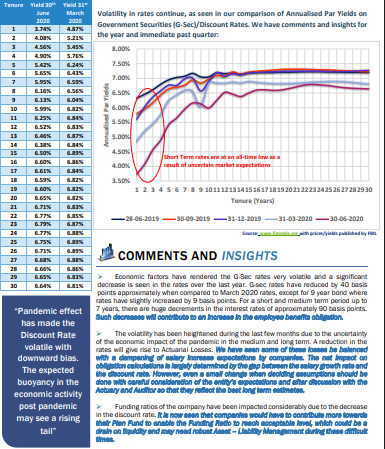
Interest Rates Updates as on 30-06-2020

June 1, 2020

Topic

IFRS 17 Existing Standard

Amendments

Likely Effects

SCOPE OF CONTRACT

IFRS 17 applies to all insurance
contracts with

some
specific
exclusions
.
Certain contracts such as credit
cards or loan contracts may also
include
significant
insurance
risk
and
to
that
extent,
the
applicability of IFRS 17 to such
contracts was not fully clear.

The
amendment
provides
clarity
on
the
applicability
of
IFRS
17
to
such
contracts
,
including
in
certain
cases
providing
:

  • Exclusion from appl
    ying IFRS 17;
    or
  • permitting
    a
    C
    ompany
    to
    apply
    either IFRS 17 or IFRS 9 to
    certain
    contracts
    (such
    as
    loan
    contracts
    with waiver on death).

Some
companies
will
avoid
incurring
IFRS
17
implementation
costs
by
applying
IFRS
9
and
other
applicable
IFRS
Standa
rds
to
account for some loans, credit
cards
and
similar
contracts,
while
still
providing
useful
information to users of financial
statements.

THE
EFFECT
OF
PREVIOUS
INTERIM
REPORTS

IFRS
17
as
originally
issued
prohibited a company

from
changing
the
estimates
made in previous

interim
financial
statements
when applying

IFRS
17
in
subsequent
interim
or annual reporting periods

The Board amended IFRS 17 to allow
an entity to make an accounting policy
choice
on
whether
to
change
the
treatment
of
accounting
estimates
made
in
previous
interim
financial
statements
when
applying IFRS
17 in
subsequent
interim
financial
statements
or
annual
reporting.
The
entity
should
apply
this
choice
consistently to all insurance contracts
issued and reinsurance contracts held.

The
amendment
helps
to
address
the
practical
issue
in
determination
of
CSM
for
interim financial reporting and
subsequently
for
annual
financial reporting on a year to
date basis. It also helps address
issues in CSM determination for
large
Groups
where
the
external
reporting
frequency
may
vary
between
the
Group
and its various subsidiaries.

TREATMENT
OF
ACQUISITION COSTS

IFRS
17
as
originally
issued
required a company to allocate
fully
and
immediately
to
a
group
of
contracts
,
acquisition
costs dir
ectly attributable to the
contracts
,
even when
a
part of
these
costs
may
relate
to
expected
future
renewal
of
such contracts.

The amendment allows Companies to:

  • Allocate
    ,
    on
    a
    systematic
    basis,
    part of the acquisition
    cost
    to
    future
    groups
    expected
    to
    aris
    e
    from
    renewal
    of current contracts
    .
  • Recognize asset in respect of
    above
    costs
    until
    the
    company
    recognizes
    the
    related group
    .
  • Assess
    the
    recoverability
    of
    the assets at each reporting
    date
    and
    where
    facts
    and
    circumstances
    i
    ndicate
    ,
    the
    asset may be
    impaired
    in full
    or in part
    ;
  • Result
    s
    in
    the
    recognition of longer
    -
    lived
    assets
    for
    acquisition costs
    ; and
  • Prevent
    s
    some
    insurance
    contracts
    from
    being
    categorized
    as
    onerous
    or
    loss
    making
    ,
    as
    the
    acquisition
    costs
    on
    these may
    exceed the
    premium of the initial
    contract
    on
    the
    expectations of
    future
    renewal
    of
    such
    contracts
    .

COVID SURVEY

M/s. K. A. Pandit, Actuaries and Consultants conducted a short dipstick survey as India entered a new financial year amongst the uncertainty and volatility around us due to the lockdown and COVID-19 situation. In particular,we have asked how companies may incorporate their short term business plans with respect to their workforce,into the assumption setting for the year end actuarial valuations.There is no doubt the opinion is that current events are going to have asignificant impact on business andmany say it will last for up to 12 months.In that light, a majority feel that short term modification of assumptions surrounding salary growth and attrition should be considered.

A Summary ofthe results of the same is illustrated here ->

Business Outlook

~ 52% say business impact will be HIGH

~ 37% say it will be MODERATE

~ 39% felt it will last 6 to 12 months whilst

~ 33% felt it will be 3 to 6 months

‍

Salary Growth Assumption

>55% feel assumption should be relooked at

~70% feel a lower assumption for 1 to 2 years followed by reverting to longer term assumption may be suitable.

Highest number of responses said 2% to 5% p.a. for a short term assumption was reasonable.

‍

Attrition Rate Assumption

Split view whether attrition assumption

~57% feel it should be modified, and a lower rate may be suitable in the short term

~42% chose an attrition assumption more than“5% to 10%” in the short term

‍

Dataset Details:

46 Companies responded over a period of 2.5 months and the results herewith are based on the updates as on 30th June 2020.

‍

WAY FORWARD AND ASSUMPTION SETTING

The world is facing unprecedented circumstances amid a pandemic whose complete financial impact is yet to be gauged. Hence, to survive through this time some companies have decided to temporarily pause salary increments or to provide deferred salary increments when times improve, whilst others have had to resort to pay-cuts and layoffs.

Whilst setting assumptions, as they are the long-term best estimated of the company, it is important that we take into consideration the future outlook and business plan of a company.

Hence it is seen that many companies are adopting staggered assumptions that reflect shorter term rates for 1-2years and then reverting to a longer term assumption. It is our recommendation to conduct an “Experience Analysis/Study” to understand past longer term trends of assumptions to set a future outlook so that it can build a basis for selecting new assumptions while simultaneously serve as a documentation for Auditors during the audit exercise.

Should you wish to revisit the assumptions considered when conducting an Actuarial valuation for your company, please feel free to contact us.

‍

Insights

Actuarial Thinking for Business Brilliance

Our Insights blend analytical rigor with strategic foresight, helping businesses navigate uncertainty with confidence. By quantifying risk and modeling future outcomes, it empowers smarter decisions, sustainable growth, and long-term value creation.

Explore All Insights

Volatility in the Interest Rate March 2017 v/s June 2017

Employee Benefit Obligations are to be valued based on G-Sec rate of estimated term as prevalent at the end of the reporting period.

Topic to be covered: Volatility in the Interest Rate March 2017 v/s September 2017

Employee Benefit Obligations are to be valued based on G-Sec rate of estimated term asprevalent at the end of the reporting period.

K. A. Pandit's Social Security and Retirement Landscape Pulse Survey 2022

It is now nearly 2 years since the Code on Social Security, 2020 was enacted. We await a notification announcing the date when it shall come into force

Ready to Transform your Business?

Get in touch with our experts.

Get in touch with our experts for personalized solutions.

Thank you! Your submission has been received!
Oops! Something went wrong while submitting the form.